According to CSS2.1 - 14.2:
The above means, for example, that:
In the following test cases a (100px × 100px square) div with 10px dotted brown border has various combinations of backgrounds, and it is wrapped in a box with a light blue grid background.
Each test is repeated three times, in the same "row":
Moreover in the first and third columns the div does not have any assigned dimensions, in the second it has one. IE7-/Win behavior changes, since in the second case the div's hasLayout property is true. IE7-/Win doesn't honor the spec, in both cases. Without hasLayout the background-position uses the border edge as reference, as with background-origin: border-box (indeed the third column is rendered the same in IE7- like in modern browsers, thanks to background-origin). With hasLayout the background is limited to the padding area, as with background-clip: padding-box (indeed the second column is rendered the same in IE7- like in modern browsers, thanks to background-clip)
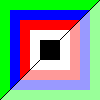
The (100px × 100px) image used as background in the tests (the zone between red and black is transparent):
The test element without any background applied to it:
yellow background-color
no background-color, image no-repeat
yellow background-color, image no-repeat
no background-color, image repeat
no background-color, image no-repeat, position 10px 10px
no background-color, image no-repeat, position -10px -10px
no background-color, image no-repeat, position 20px 20px
The background-color and the background-image repetition extend under the border in all modern browsers, including Firefox, Safari, Opera, IE8+. In IE7-/Win this only occurs in absence of hasLayout on the box with background (with hasLayout the background is confined to the padding area).
The extension can (in modern browsers including Firefox, Safari, Opera, IE9+) be controlled with background-clip. So, for example, the background-color and the background-image repetition stay within the padding area (do not extend under the border) in Firefox, Safari, Opera, IE9+ all with background-clip:padding-box, and this can also be obtained in IE7-/Win with hasLayout.
The top left of the background-image is at the outer padding edge in all modern browsers, including Firefox, Safari, Opera, IE8+. In IE7-/Win this only occurs in presence of hasLayout on the box with background (without hasLayout the top left of the background-image is at the outer border edge).
The top left (origin) of the background-image can (in modern browsers including Firefox, Safari, Opera, IE9+) be controlled with background-origin. So, for example, the top left (origin) of the background-image can be set at the outer border edge in Firefox, Safari, Opera, IE9+ all with background-origin:border-box, and this can also be obtained in IE7-/Win without hasLayout.
Other similar background, border and hasLayout tests just for IE7-/Win.